Homam & Havan
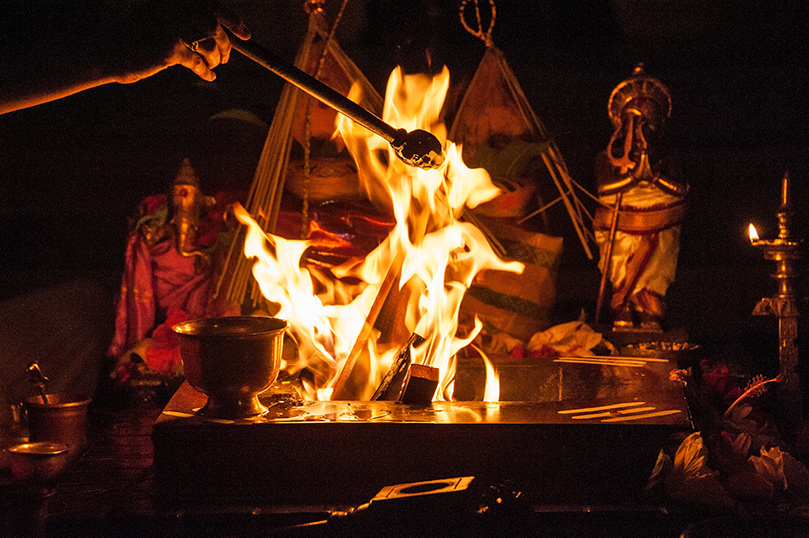
Agni, the Holy Fire: Agni, The fire God, plays a pivotal role while performing the Havan. Agni is considered the mouth of the Gods and Goddesses and, the medium that conveys offerings to them in a Havan. Agni is part of many Hindu rites-of-passage ceremonies such as celebrating a birth (lighting a lamp), prayers (aarti lamp), at weddings (the yajna where the bride and groom circle the fire seven times) and at death (cremation).
अग्निमीळे पुरोहितं यज्ञस्य देवमृत्विजम् । होतारं रत्नधातमम् ॥१॥
Rig Veda (the Oldest of the four Vedas) begins with the above Shlokam. This highlights the supreme position of Agni, mentioned as the foremost Purohit (purohit: ‘puras’ meaning front and foremost; ‘hita’ meaning placed). Agni is the first before all. The Fire God, Agni leads the worshipper towards the right path for achieving the desired goals, Just like a man carrying the torch, in the dark followed by others (living in ignorance).
Homam (होमम्) also known as Havan (हवन्) or Yajna (यज्न्) is a holy vedic ritual performed by practitioners with the guidance of a vedic priest. It is a process of invoking a sacred fire called Agni (अग्नि) with intentions of cleansing one’s self (material and spiritual), and the environment.
The fundamental steps in any Homam procedure focus on starting and maintaining the sacred fire, while Vedic Mantras are chanted in harmony.